
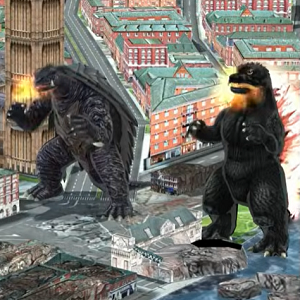
Godzilla and Gamera
CBUB Wins: 0
CBUB Losses: 0
CBUB Ties: 0
Win Percentage: 0%
Added by: Venom 2009
Kaiju (from , ), or giant movie monster, are terms used in film and media for monsters, and the like, of enormous size, mainly belonging to a designated genre, known as kaiju movies, or giant monster movies, where they are usually depicted attacking major cities, and battling either the military or other creatures, mixing creature feature with the disaster film genre, but also often involving science fiction. Examples include famous movie monsters like King Kong, Godzilla and Gamera, cult classic like The Beast from 20,000 Fathoms, It Came from Beneath the Sea, Them!, The Giant Claw, and modern examples like Cloverfield, among others. Related media also includes various "mecha", which often revolve around giant robots fighting giant monsters, such as Voltron, Power Rangers, Evangelion, Megas XLR, Pacific Rim, etc.
Historically, giant movie monsters were known in Japanese as daikaijū ( ), however the broader term of "kaiju" has largely replaced this. The term can refer to the monsters themselves or the movie genre in which they appear. In contrast to "giant movie monster", the term "kaiju" is generally used to specifically refer to the Japanese style of giant monster media, which traditionally uses actors in monster suits and scale model sets. Its widespread contemporary use is credited to tokusatsu (special effects) director Eiji Tsuburaya and filmmaker Ishirō Honda, who popularized the Japanese kaiju film genre by creating the Godzilla franchise and its spin-offs.
The first "giant monster movie" is debatable. The 1921 animated short film The Pet (1921) features a giant monster attacking a city, and the 1925 silent feature film The Lost World famously features a dinosaur being brought to the streets of London, subsequently inspiring the creators to make the 1933 movie King Kong. The Japanese style of giant monster movies with suitmation starts as early as the 1930s with movies such as Wasei Kingu Kongu (1933), The Great Buddha Arrival (1934), and The King Kong That Appeared in Edo (1938). The first Japanese "kaiju movie" to see international success is the 1954 feature Godzilla. When developing it, creators drew inspiration from the character of King Kong, both in its influential 1933 film and in the conception of a giant monster, establishing it as a pivotal precursor in the evolution of the genre. During their formative years, kaiju movies were generally neglected by Japanese critics, who regarded them as "juvenile gimmick", according to authors Steve Ryfle and Ed Godziszewski.
Kaiju are often somewhat metaphorical in nature; Godzilla, for example, initially served as a metaphor for nuclear weapon, reflecting the fears of post-war Japan following the atomic bombings of Hiroshima and Nagasaki and the Lucky Dragon 5 incident. Other notable examples of kaiju include Rodan, Mothra, King Ghidorah, Gamera, and King Kong.
CBUB Match Record:
No Regular Play Records Available
No Fantasy Draft Records Available